














Academic Guidance and Counseling Center
Vision :
Mission :
Objectives of the center :
Academic advising is a psycho-educational process that includes three main areas: Information, guidance, and counseling, which are
necessary services to prepare the university student psychologically, socially and academically to face the difficulties of life and adapt to them in general, and to cope with university life and adapt to it, especially since academic counseling services have become a prominent goal of higher education aimed at building personalities that interact with a rapidly changing society.
of higher education’s goals to build personalities that interact with a rapidly changing and accelerating society. The academic counselor seeks to help students discover their abilities and facilitate their use in solving any difficulties they may encounter, thus achieving success and excellence in their studies.
study. In order for the academic counselor to successfully carry out this educational mission, he must be based on a work plan that clarifies his counseling tasks and the educational goals to be achieved for the benefit of the student.
and the educational goals that should be achieved in the interest of the student’s academic adaptation, which in turn contributes to the success of the educational process and the university’s fulfillment of its mission to serve the community.
This is through the following objectives:
1. Establishing, developing, and following up academic advising policies with the academic advising committees in the faculties.
2. Spreading the culture of academic advising among faculty members and students and activating the use of its services.
3. Preparing new students to learn about university life and the study system through guidance programs.
4. Developing the capabilities of academic advisors and increasing their awareness of academic advising.
5. Supervising the application of the procedures and instructions of academic counseling and student support in the colleges and following up on their implementation.
6. Provide students with suggestions and advice to improve their academic achievement and help them overcome their academic and administrative issues.
7. Overcoming obstacles that hinder the academic achievement of struggling students.
8. Work to consolidate the relationship between students and faculty members and build social relations for the student with his/her colleagues.
9. Studying the negative behavioral phenomena of some students and working to find appropriate solutions for them.
10. Caring for outstanding students, guiding them and helping them to continue to excel.
11. Paying attention to talented students and supporting their creativity.
12. Helping students of the final teams and preparing them for practical life to enable them to succeed in various jobs and serve the community.
13. Urging students to adhere to the ethics of the university student and civilized behavior and to demonstrate the qualities of the student of science and his manners with his professors and colleagues
14. Helping students with special needs to achieve scientific achievement and social and psychological adaptation and studying their problems and working to solve them.
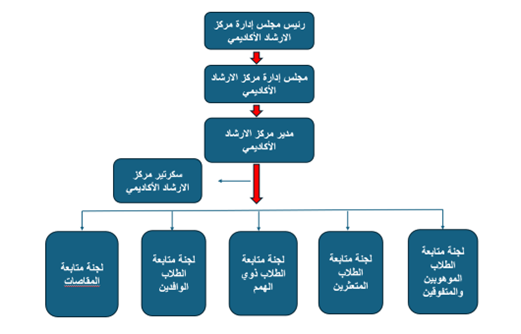
The organizational structure of the Academic Advising Center :
The Academic Advising Center consists of a board of directors headed by the Vice President for Education and Student Affairs and the members of the board of directors are as follows:
– Center Director
– Directors of academic counseling units in colleges
– A representative of the University’s Student Affairs Department
– A representative of the university’s e-services department
The organizational structure of the Academic Advising Center consists of several committees as shown in the following figure: